
What Are Multifocal and Trifocal IOLs?
During cataract surgery, your eye’s cloudy natural lens is removed to restore clarity, and a clear artificial intraocular lens (IOL) is implanted to provide the focusing power. Standard monofocal IOLs are set for a single focal point, most often distance, so reading glasses are typically needed. Multifocal and trifocal IOLs are presbyopia-correcting options designed to reduce dependence on glasses by delivering functional vision at more than one distance.
How They Differ From Monofocal and EDOF IOLs
Monofocal IOLs provide one focus. Extended depth-of-focus (EDOF) IOLs stretch the focus over a range, often emphasizing distance and intermediate with limited near. Multifocal and trifocal IOLs use optical designs that create two or three distinct focal points to expand usable near and intermediate vision beyond what monofocal and many EDOF lenses provide. Your surgeon will help you compare which approach best aligns with your priorities.
How Concentric Zones Create Multiple Focus Points
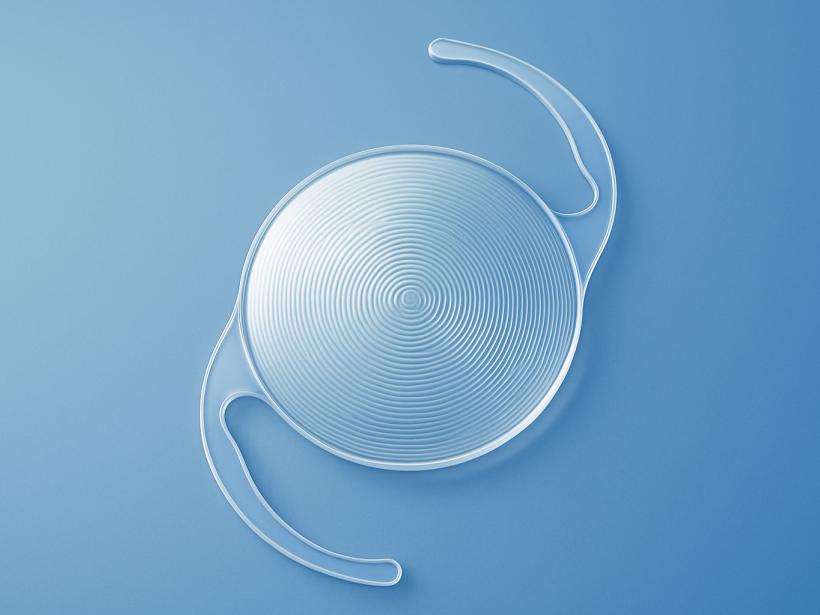
Most multifocal and trifocal IOLs use diffractive optics—microscopic, concentric rings on the lens surface that split incoming light into separate focal points. The goal is to deliver functional vision at:
- Distance for driving and outdoor activities
- Intermediate for computer work, dashboards, and countertops
- Near for reading phones, books, and labels
Multifocal lenses typically prioritize distance and near, with some intermediate function depending on design. Trifocal lenses deliberately add a distinct intermediate focal point to better support arm’s-length tasks like computer use. Many designs “weight” light distribution to favor distance vision in bright conditions and balance day-to-night performance. Although the details vary by manufacturer, the aim is similar: a broad, practical range of vision for everyday life.
Multifocal vs. Trifocal: What’s the Difference?
Both lens types aim to reduce the need for glasses. Multifocal IOLs often emphasize distance and near, while trifocals are engineered to strengthen the intermediate range. People who spend significant time on a computer or tablet may especially value the intermediate boost of a trifocal. Candidacy and selection depend on your eye measurements, corneal shape, pupil behavior, and visual goals.
Benefits You Might Notice
- Less dependence on glasses: Many people can manage most daily activities—driving, shopping, computer work, and reading—without glasses. You may still choose readers for very fine print or prolonged low-light reading.
- Broader range of focus: Compared with a monofocal set for distance or near only, these lenses are designed to provide functional vision across multiple distances, especially when both eyes are working together.
- Convenience and lifestyle fit: Fewer situations that require switching glasses for work, errands, and travel can be a meaningful quality-of-life benefit.
- Binocular vision planning: Surgeons often fine-tune targets between eyes (for example, tiny differences or “mini-monovision”) to smooth the range of focus while aiming to preserve depth perception.
It is important to set realistic expectations. While many people achieve a high degree of spectacle independence, no lens guarantees complete freedom from glasses. Results vary with the lens design, the health and optics of your eyes, and healing.
Trade-offs and Side Effects to Understand
Because these lenses split light between focal points, some trade-offs are possible:
- Halos, glare, or starbursts: Rings or scatter around lights are common early, especially at night. They often lessen over weeks to months but can persist in a minority of people.
- Reduced contrast, particularly in dim light: Fine details may be less crisp under low-contrast conditions. Brighter task lighting can help for menus, labels, and crafts in the evening.
- Night driving sensitivity: Some people remain aware of halos with nighttime driving and may prefer glasses for certain conditions.
- Reading “sweet spot” and lighting needs: You may adjust how far you hold items and prefer brighter, directed light.
- Dry eye effects: Ocular surface dryness can blur or fluctuate vision and exaggerate halos. Treating dryness can significantly improve perceived quality.
- Optic centration and pupil size: Multifocal optics are sensitive to decentration and very large pupils in dim light, which can influence quality of vision.
- Less common phenomena: A temporal shadow (“negative dysphotopsia”) can occur early and usually improves; persistent cases are uncommon.
Not everyone adapts fully to the optical trade-offs. Careful screening, precise measurements, and realistic expectations are key to satisfaction.
Neuroadaptation: How Your Brain Adjusts
Neuroadaptation is the brain’s process of prioritizing the in-focus image and “tuning down” defocused images from other focal points. This typically takes weeks to months and often improves further after both eyes are completed.
- Timeline: Early halos and contrast changes are common, often improving over 1–3 months and sometimes longer.
- Practical tips: Use good task lighting, follow your surgeon’s dry eye plan, and allow time for both eyes to heal. Avoid drawing conclusions about final vision until refraction stabilizes.
- Adjustments: If small refractive errors remain, task-specific glasses or a laser enhancement may be considered after stability. If a toric IOL rotates, early repositioning can help. Decisions are individualized.
If posterior capsule clouding (“secondary cataract”) develops later, a laser procedure (Nd:YAG capsulotomy) can restore clarity. This laser treats capsule haze, not optical halos, and its timing matters because it can make any future IOL exchange more complex. Your surgeon will guide the sequence of any steps.
Who Is a Good Candidate?
Success begins with careful selection and precise measurements. You may be a strong candidate if you:
- Have a healthy cornea, macula, and optic nerve on exam
- Have regular corneal shape and stable measurements
- Have manageable ocular surface dryness and are willing to treat it
- Desire less dependence on glasses for a range of tasks
- Are comfortable with a period of adaptation and the possibility of halos or glare
- Understand that occasional glasses may still be useful for fine print or very low light
If you have astigmatism, your surgeon may recommend a toric version of a multifocal or trifocal lens to correct regular corneal astigmatism. Toric IOLs do not correct irregular astigmatism. Accurate corneal measurements, alignment, and rotational stability are essential to get the most from these lenses.
Who May Not Be an Ideal Candidate?
Presbyopia-correcting lenses are not right for everyone. You may be counseled to consider other options if you have:
- Macular disease (e.g., age-related macular degeneration or significant diabetic retinopathy/diabetic macular edema)
- Glaucoma with visual field loss or reduced contrast sensitivity
- Irregular cornea (keratoconus, significant higher-order aberrations, corneal scars) or prior radial keratotomy
- Fuchs endothelial dystrophy or corneal guttae with compromised corneal clarity
- Zonular weakness or pseudoexfoliation that may affect IOL centration and stability
- Severe, uncontrolled dry eye or meibomian gland dysfunction
- Large mesopic pupils combined with heavy night driving demands, or occupational needs where halos are unacceptable (for example, pilots or certain professional drivers)
- History of complex eye surgery that affects measurements or image quality; prior LASIK/PRK requires careful evaluation and counseling
- Unrealistic expectations or very low tolerance for visual phenomena
Your surgeon may recommend alternatives such as a monofocal lens with readers, monovision, or an EDOF lens, aiming for the best overall quality of vision for your eyes and lifestyle.
Surgery Planning and Customization
Achieving a good outcome with multifocal or trifocal IOLs depends on precision at every step:
- Contact lens holiday: If you wear contact lenses, a period out of lenses before measurements can improve accuracy, especially with rigid or toric lenses.
- Biometry and topography: Detailed measurements guide IOL power, selection of optics, and toric axis alignment.
- Ocular surface optimization: Treating dryness, blepharitis, or allergies before measurements improves accuracy and postoperative clarity.
- Target strategy: Many people are set for distance in both eyes; some benefit from mini-monovision to fine-tune near or intermediate. The plan considers eye dominance, pupil behavior, and your tasks.
- Astigmatism management: Toric IOLs, strategic corneal incisions, or a combination may sharpen vision across distances.
- Intraoperative alignment and centration: Proper centration on the visual axis and stable toric alignment are especially important for multifocal optics.
Your surgeon may also consider intraoperative measurements, the need for capsular support in eyes with weak zonules, and lens design features to match your goals (for example, extra emphasis on intermediate for a computer-based job).
After Surgery: Healing, Adaptation, and Adjustments
Most people notice clearer distance vision quickly, with near and intermediate improving as healing progresses and after the second eye is completed. Early fluctuations are common.
- Second eye timing: Many surgeons schedule the second eye soon after the first to speed binocular adaptation.
- Enhancements: If a small refractive error remains after healing, options may include a light pair of glasses for certain tasks or a laser touch-up, depending on eye health.
- Toric rotation: If a toric IOL rotates off axis, early repositioning can restore clarity.
- Posterior capsule opacification: Months or years later, a cloudy membrane can blur vision or increase glare. An Nd:YAG laser often restores clarity when appropriate. Because it does not treat halos and complicates any later IOL exchange, timing is individualized.
- IOL exchange: Rarely, if visual symptoms remain unacceptable and other causes have been addressed, exchanging the lens may be discussed. Early evaluation is helpful before considering any capsule laser.
Call your surgeon urgently for increasing pain, sudden vision loss, a curtain over vision, or new flashes/floaters.
Daily Life With Multifocal or Trifocal IOLs
- Lighting: Use brighter, directed light for small print or crafts, especially in the evening.
- Reading distance: Adjust how far you hold items to find your clearest range.
- Nighttime awareness: Expect halos and glare early on; many find these fade with time. Clean windshields and lenses can help reduce scatter.
- Dry eye care: Preservative-free tears, lid hygiene, and other treatments recommended by your clinician can stabilize vision.
Cost and Insurance Considerations
In the United States, medically necessary cataract surgery is typically covered by insurance or Medicare. Presbyopia-correcting IOLs (multifocal or trifocal) and their customization are generally considered premium upgrades with out-of-pocket costs. Toric IOLs to correct astigmatism are also often an additional expense. Coverage details vary, so ask your surgeon’s office and insurer what is included and what financing options are available.
Questions to Ask Your Surgeon
- Based on my eye exam, am I a good candidate for a multifocal or trifocal IOL?
- How will you tailor the plan for my daily activities, especially computer use and night driving?
- What side effects should I expect early on, and what is the typical adaptation timeline?
- Will I need a toric lens for my astigmatism, and how will you align and stabilize it?
- If I have residual blur after healing, what adjustment options do we have, and when would you consider them?
- What are my out-of-pocket costs, and what is included in the package of care?
This article is educational and not medical advice. The choice of IOL and surgical plan should be individualized after a comprehensive exam and discussion with your ophthalmologist.
Sources
- American Academy of Ophthalmology — Presbyopia-correcting IOLs
- Cochrane — Trifocal versus EDOF IOLs
- Cochrane — Multifocal versus monofocal IOLs