
What is corneal astigmatism?
Astigmatism is a focusing error caused most commonly by uneven curvature of the eye’s clear front window (the cornea). Instead of being evenly rounded like a basketball, the cornea is steeper in one direction and flatter in another—more like a football. This shape bends light unevenly, so images can look blurred, smeared, or ghosted at all distances.
Astigmatism can also come from the natural lens inside the eye (lenticular astigmatism). During cataract surgery, the cloudy natural lens is removed, so any lens-based astigmatism is eliminated. What remains is primarily corneal astigmatism. Glasses and contact lenses can correct corneal astigmatism at the surface. During cataract surgery, you also have an opportunity to address regular corneal astigmatism inside the eye with a toric intraocular lens (IOL).
How a toric IOL corrects astigmatism
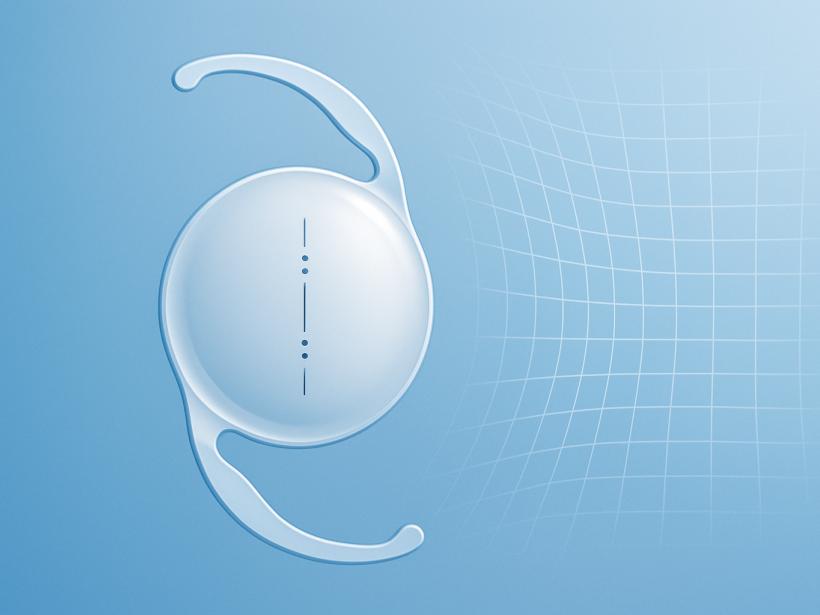
A toric IOL is an artificial lens with built-in astigmatism power. It has different focusing strengths in different meridians, matched to the pattern of your corneal curvature. When placed at the proper angle (axis) inside the eye, a toric IOL helps neutralize the cornea’s uneven focusing, reducing or sometimes eliminating the need for astigmatism-correcting glasses. Toric IOLs correct regular corneal astigmatism; they are less predictable for irregular astigmatism (for example, from keratoconus or corneal scarring).
Toric optics can be combined with several IOL designs:
- Monofocal toric: Targets clear vision at a single focal point, most often distance. This design tends to have fewer night-vision side effects than presbyopia-correcting optics. Most people still use readers for near.
- Extended depth of focus (EDOF) toric: Stretches the range of clearer vision, often improving intermediate tasks (computer, dashboard) and some near tasks. Mild halos or glare at night can occur.
- Multifocal or trifocal toric: Splits light into multiple focal points to reduce reliance on glasses at distance, intermediate, and/or near. Some people notice halos, glare, or reduced contrast, especially in dim light.
Why precise axis alignment matters
With astigmatism, the direction (axis) of the cornea’s steepest curve is critical. A toric IOL must be aligned to the same axis to counterbalance the cornea’s uneven power. If the IOL is off-axis or rotates after surgery, the astigmatism correction is reduced and may even induce new blur or ghosting. Early postoperative rotation can often be corrected by gently rotating the lens back to the intended axis. As the capsule around the lens heals and tightens over weeks, the IOL typically becomes more stable.
Because alignment is so important, careful measurements and planning are part of every toric IOL case. Details such as subtle eye rotation when lying down (cyclotorsion), head tilt, wound placement, and expected surgically induced astigmatism are considered to help achieve accurate positioning.
Measurements and alignment techniques
Your surgical team uses multiple tests to plan a toric IOL and to cross-check accuracy:
- Keratometry and corneal topography/tomography: Map the cornea’s curvature and measure the magnitude and axis of astigmatism. When indicated, measurements also account for the back surface of the cornea, which contributes to total astigmatism.
- Ocular biometry: Measures eye length, corneal dimensions, and anterior segment parameters to calculate IOL power and predict lens position.
- Astigmatism calculators: Planning tools that incorporate posterior corneal power and surgical factors that can subtly change corneal shape.
To align the lens accurately, surgeons may use:
- Preoperative reference marks: Small ink marks on the eye while you are upright to account for natural eye rotation when you lie down.
- Intraoperative image guidance or aberrometry: Systems that help confirm axis and power in real time during surgery.
- Alignment marks on the IOL: Tiny dots or lines on the lens guide rotation to the intended axis.
A stable, healthy ocular surface improves measurement reliability. Treating dry eye or blepharitis before testing, and taking a contact-lens “holiday” before biometry when advised, can make results more accurate.
Toric options: monofocal, EDOF, and multifocal
Choosing a toric IOL involves more than correcting astigmatism. You and your surgeon will discuss how you use your eyes every day—work, hobbies, night driving, and tolerance for visual side effects—to select a lens type.
- Monofocal toric: Well suited for people who want crisp distance vision with the lowest likelihood of night-vision symptoms and are comfortable using readers for near. Some choose mini-monovision (one eye for distance, the other slightly nearsighted) to reduce glasses dependence; this can affect depth perception and may benefit from a contact lens trial beforehand.
- EDOF toric: A middle-ground option that can offer a broader range of focus than a monofocal, often with fewer halos than multifocal designs, though night glare can still occur.
- Multifocal/trifocal toric: Aim to reduce glasses dependence across distances. They can create rings or halos around lights and may reduce contrast, particularly in dim conditions. Careful patient selection and counseling are important, and neuroadaptation can take weeks to months.
Your surgeon will help you weigh these choices based on eye health, lifestyle, pupil size, and your sensitivity to glare/halos. Toric features and presbyopia-correcting optics are typically elective upgrades. In the United States, these options are often out-of-pocket additions to standard cataract surgery; coverage varies by plan.
Who is a candidate for a toric IOL?
Good candidates generally have regular corneal astigmatism that is stable and significant enough to affect their vision goals. Candidacy also depends on overall eye health, measurement reliability, and expectations.
Factors that support candidacy
- Regular, consistent astigmatism confirmed across multiple tests.
- Healthy tear film and corneal surface (dry eye is treatable but should be optimized for accurate measurements).
- Clear vision goals, such as reducing dependence on glasses for distance or across a range of distances.
Factors that may limit or change the plan
- Irregular astigmatism from corneal disease (for example, scarring or keratoconus) may not be corrected predictably with a toric IOL; specialty contact lenses may still be needed.
- Macular disease (e.g., age-related changes) or optic nerve disease (e.g., glaucoma that affects contrast) can limit the benefit of presbyopia-correcting designs; a monofocal toric may be preferred.
- Corneal endothelial disease (such as Fuchs dystrophy) can reduce contrast and increase glare; multifocal optics are often avoided.
- Very large pupils or frequent night driving may increase awareness of halos with multifocal designs.
- Prior refractive surgery (LASIK/PRK/RK) can affect measurements and outcomes; experienced planning is essential and may influence lens choice.
- Zonular weakness (e.g., pseudoexfoliation) or unusual eye anatomy can make rotation control more challenging and may call for additional stabilizing techniques.
Alternatives to toric IOLs
- Glasses or contact lenses: A non-toric IOL can be paired with glasses or toric contact lenses after surgery to correct residual astigmatism.
- Limbal relaxing incisions (LRIs) or arcuate keratotomy: Precisely placed corneal incisions that can reduce low to moderate astigmatism at the time of cataract surgery. Effectiveness depends on corneal characteristics; stability and accuracy vary.
- Laser vision correction after surgery: Procedures such as PRK or LASIK can fine-tune remaining astigmatism once vision is stable, when appropriate.
What to expect during and after surgery
Cataract surgery is typically an outpatient procedure. After numbing the eye, the cloudy natural lens is removed to restore clarity, and the toric IOL is implanted to provide focusing power and astigmatism correction. The surgeon rotates the lens to the planned axis using alignment marks and guidance systems as needed.
It’s common for vision to fluctuate for days to weeks as the eye heals. If the toric IOL rotates early on, some patients notice new blur or ghosting; when appropriate, the surgeon can reposition the lens. A laser opening in the capsule to treat a cloudy membrane (posterior capsule opacification) is generally delayed until lens position is stable because creating that opening later makes IOL rotation or exchange more complex.
Even with excellent surgery, you may still need glasses for some activities. This is most noticeable for near tasks with monofocal lenses. If a small amount of astigmatism or nearsightedness/farsightedness remains and bothers you, options such as glasses, contact lenses, corneal laser enhancement, or, less commonly, lens repositioning or exchange may be discussed. Neuroadaptation to presbyopia-correcting optics can take weeks to months.
Call your surgeon urgently for increasing eye pain, sudden vision loss, new flashes of light, or a shower of new floaters after surgery.
Risks, tradeoffs, and side effects
All cataract surgery carries risks such as infection, inflammation, bleeding, retinal detachment, elevated eye pressure, or swelling in the cornea or retina. Serious complications are uncommon but can threaten vision. Your surgeon will review these with you.
Toric IOL–specific considerations include:
- Lens rotation or misalignment: Reduces the effectiveness of astigmatism correction and may require repositioning.
- Residual refractive error: Because toric IOLs come in set power steps and surgical healing varies, some cylinder or spherical power may remain; glasses or a touch-up procedure may be considered.
- Night-vision phenomena: Glare or halos can occur with any IOL and tend to be more noticeable with EDOF and multifocal optics. These symptoms often improve with time but can persist in a minority.
- Posterior capsule opacification (PCO): Over time, a cloudy membrane behind the IOL can blur vision and is treatable in the clinic with a brief Nd:YAG laser procedure. This laser treats PCO, not optical halos, and timing matters because it makes later IOL rotation or exchange more challenging.
Costs and insurance
While standard cataract surgery is commonly covered by insurance, toric features and presbyopia-correcting optics are typically elective upgrades. In the United States, these options usually involve out-of-pocket costs that vary by plan and provider. Ask your surgeon’s office for a written estimate, including potential fees for enhancements if needed.
Questions to discuss with your ophthalmologist
- How much corneal astigmatism do I have, and is it regular or irregular?
- Which toric IOL options (monofocal, EDOF, multifocal) fit my lifestyle and tolerance for glare or halos?
- How will you align the lens, and what is the plan if rotation occurs?
- What are realistic expectations for glasses use after surgery? Would mini-monovision suit me, and should I try it with contact lenses first?
- How will dry eye or contact lens wear affect my measurements? Do I need a contact lens “holiday” before testing?
- What alternatives exist if I choose not to have a toric IOL, or if residual astigmatism remains?
- What are the costs, including any out-of-pocket fees for toric or presbyopia-correcting features?
The bottom line
A toric IOL can effectively address regular corneal astigmatism at the time of cataract surgery and can be paired with monofocal, EDOF, or multifocal optics depending on your goals. Accurate measurements, precise alignment, ocular surface optimization, and open discussion of tradeoffs help set the stage for clear, comfortable vision.
This article is educational and not a substitute for medical advice. Decisions about IOL selection are individualized and should be made with your ophthalmologist.
Sources
- American Academy of Ophthalmology — IOLs for cataract surgery
- American Academy of Ophthalmology — Choosing an IOL
- National Eye Institute — Cataracts